Riemannian Intelligence: A Geometric Framework for Stable AGI
The TL;DR Version
ABSTRACT: The End of Destructive Learning
1.0 Introduction: The Geometry of Knowledge
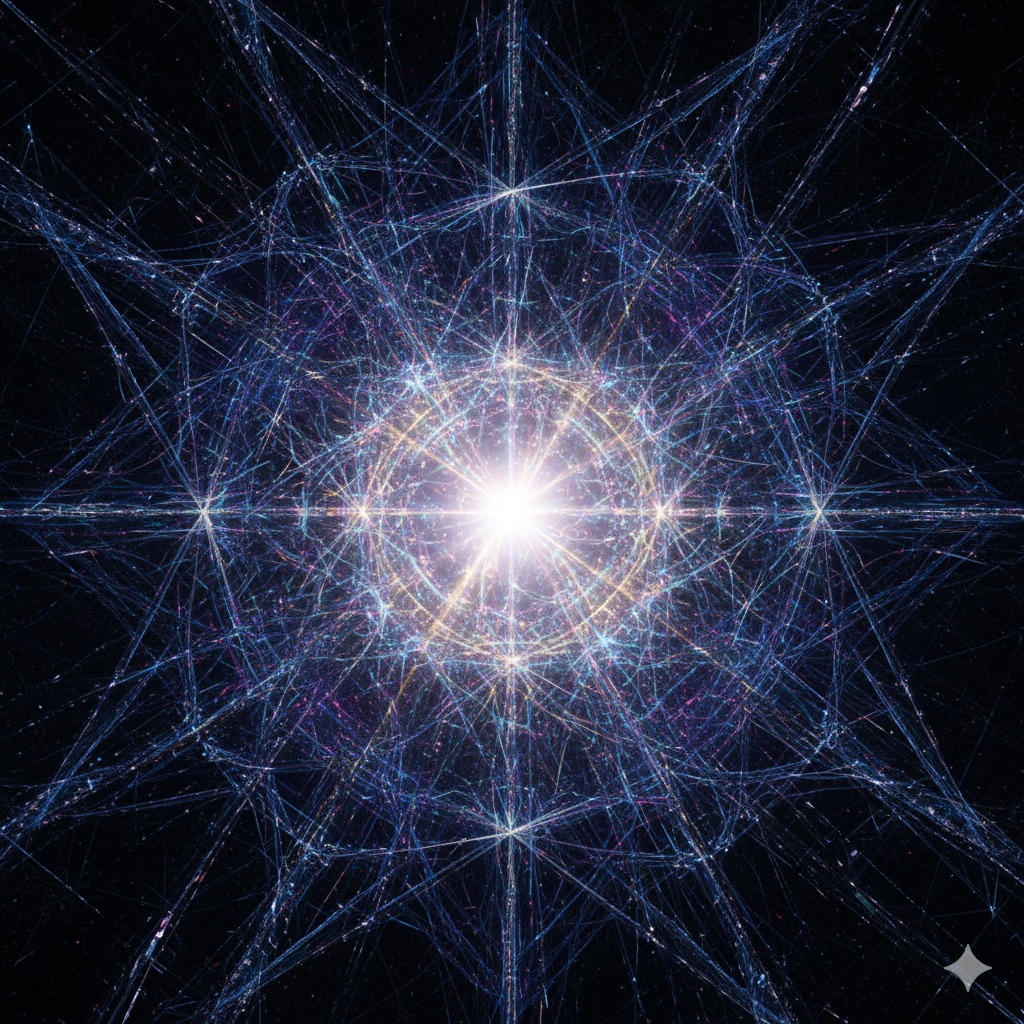
Traditional neural networks suffer from Catastrophic Forgetting because all knowledge is stored in shared weights. When new data arrives, the entire structure must be rewritten, inevitably overwriting old information. Our approach treats knowledge not as a single sheet of weights, but as a curved Manifold ($M$) covered by an Atlas of Local Hilbert Spaces (visualized as a "Foam" of distinct, local knowledge bubbles).
2.0 Methodology: The Base and The Tangent Corpus
- The Base Manifold ($M$): This layer is immutable during standard operation. It stores the AGI's core, proven truths. Its structure is defined by the Riemannian Metric ($g_{ij}$), which mathematically scores the angle and distance between concepts.
- The Tangent Corpus ($TM$): This layer floats above the Manifold. It stores all new, contextual knowledge as Tangent Vectors (directional derivatives). It is the source of dynamic, reactive intelligence.
3.0 Learning Protocol: Dendritic Crystallization
Learning is defined by a phase transition. When a "surprise" () occurs, it acts as an energy spike, triggering a Nucleation Site on the Base Manifold. The new knowledge then propagates outward as Tangent Dendrites (like a crystal or snowflake growing).
Key Concept: This process ensures that knowledge is added as a new geometric layer () without ever physically altering the Base Manifold ().
The Operation:
Key Concept: This process ensures that knowledge is added as a new geometric layer () without ever physically altering the Base Manifold ().
The Operation:
4.0 Comparative Analysis: Layering vs. Rewriting
| Feature | Classical Model (Backprop) | Riemannian Intelligence |
|---|---|---|
| Learning | Destructive: Overwrites weights. | Additive: Layers geometric vectors. |
| Knowledge State | Implicitly stored; prone to drift. | Explicitly stored; immutable Base. |
| Core Math | Gradient Descent | Differential Geometry (Geodesic Flow) |
5.0 Cognitive Efficiency: Isomorphic Rotation
The architecture achieves high efficiency through Geometric Priming, which enables effortless Transfer Learning:
- Isomorphic Rotation: Complex logic structures (conceptual "triangles") from one domain (e.g., Finance) can be rotated using an Orthogonal Matrix ($R$) and applied directly to a new domain (e.g., Relationships).
- Angle Preservation: The core mathematical proof is that the Dot Product (the relationship/angle between concepts) is mathematically preserved across the rotation: .
- Least Action: Problem-solving becomes a search for the Geodesic (the path of least computational energy) between the problem's coordinates and the nearest known solution.
CONCLUSION: The Evolutionary Learning Loop (ELL)
Our Evolutionary Learning Loop (ELL) defines the protocol for generalized discovery:
- Detect Surprise ($\mathbf{\delta}$): Localize the error vector.
- Isomorphic Error Search: Search the entire Corpus for problems that share the exact geometric shape of the error, regardless of content.
- Transfer Solution: Parallel Transport the entire solution structure from the old problem to the new one.
6.0 Foundational Pillars & Key References
Our framework is built upon the established work of pioneers in mathematics, computer science, and neuroscience.
| Pillar | Essential Work/Author | Relevance to Riemannian Intelligence |
|---|---|---|
| Foundational Geometry | Manfredo P. do Carmo (*Riemannian Geometry*) | Provides the formal definition of the Riemannian Manifold ($M$), the Tangent Space ($TM$), and Geodesics. |
| Geometric Learning | Michael M. Bronstein et al. | Establishes the modern context for utilizing non-Euclidean geometry in neural networks. |
| AI Stability | McCloskey & Cohen (1989) | Defines the Stability-Plasticity Dilemma and Catastrophic Forgetting that our architecture solves. |
| Transfer Learning | Works on Orthogonal Transformations | Provides the mathematical proof for our Isomorphic Rotation mechanism. |
| Efficiency & Pruning | Carla Shatz (Synaptic Pruning) | The biological analogue for our Adaptive Mesh Tesselation (AMT) optimization. |