Topological Peristalsis: Riemannian Geodesic Flows as a High-Efficiency Bridge for Hybrid Quantum-Classical State Selection
Author: Gwendalynn Lim Wan Ting, Independent Researcher & Incoming AI/ML Scholar (NTU)
Date: December 21, 2025
1. Executive Summary: The Geometric Solution
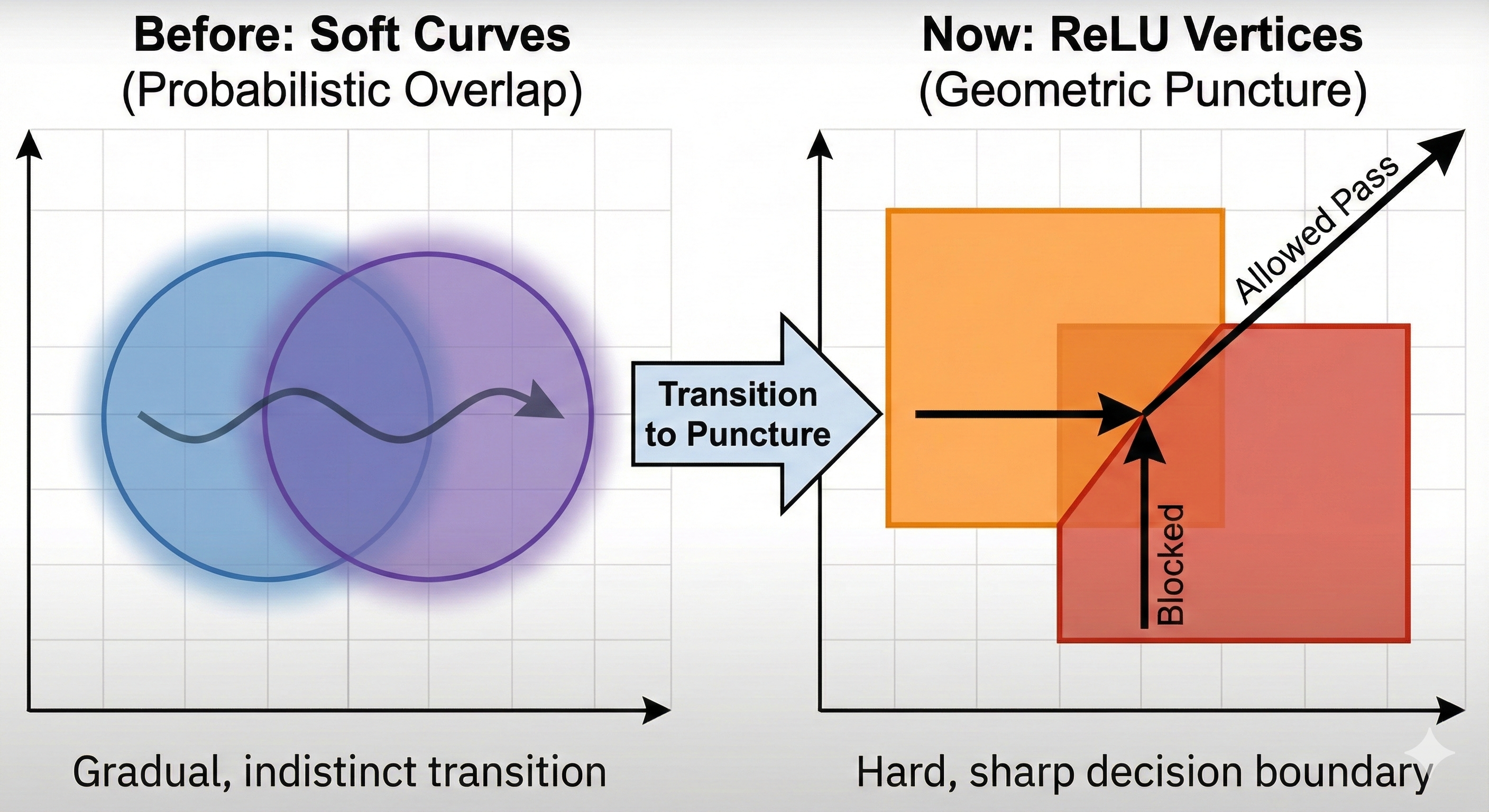
1. Visualizing the "Puncture"
The sharp angle of the ReLU function within the intersection is the literal "Puncture." It visualizes a hard decision boundary imposed by geometry. It shows that the signal doesn't just "slide" into the solution; it hits a distinct geometric wall where it is either blocked or allowed to pass.
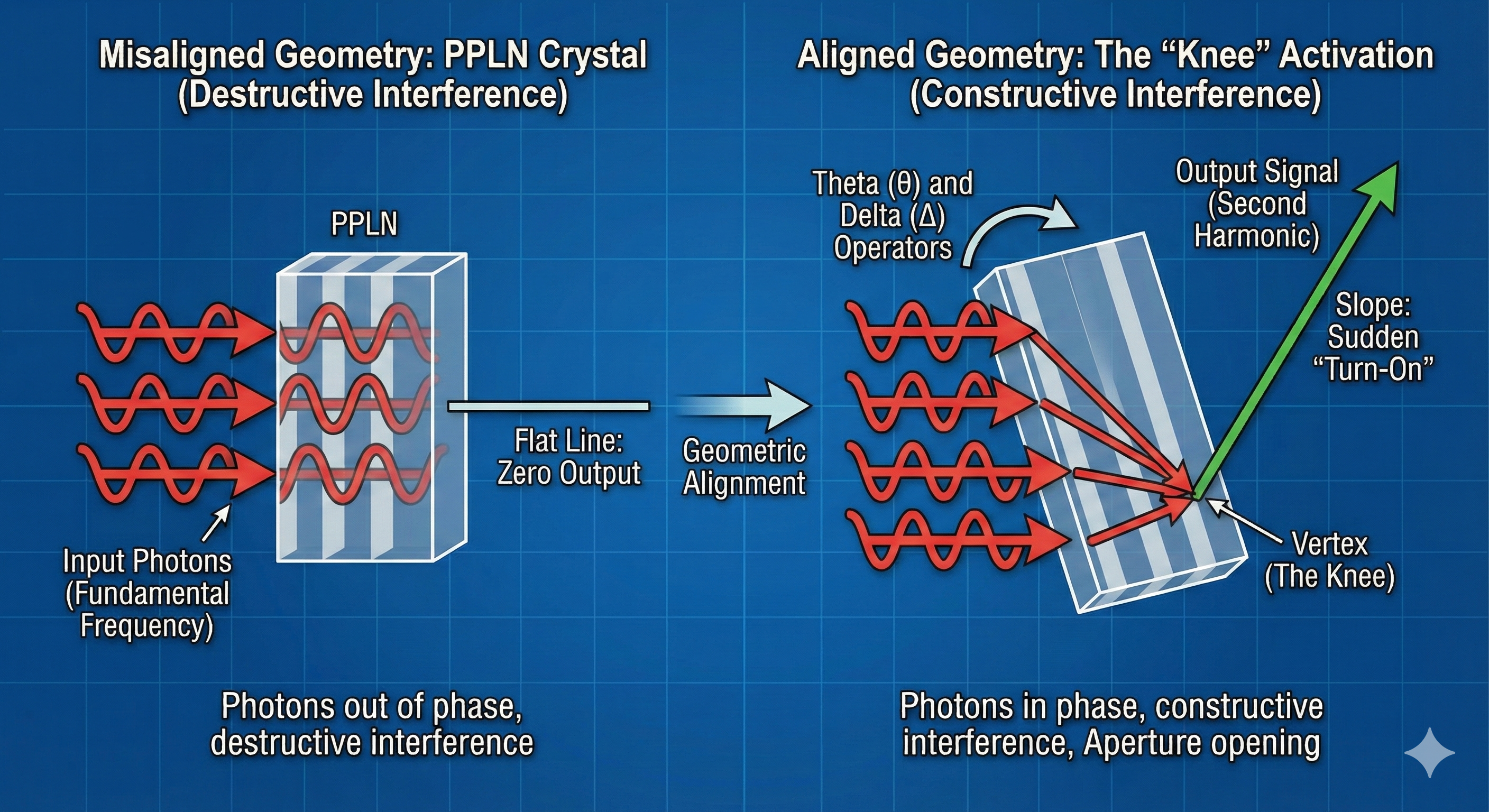
2. The Physics of the Vertex
This activation isn't software; it's a geometric inevitability. The 'flat line' represents the system when geometry is misaligned (destructive interference). The 'vertex' is the exact moment the operators align the state with the crystal's geometry, and the 'slope' is the sudden, constructive turn-on of the signal.
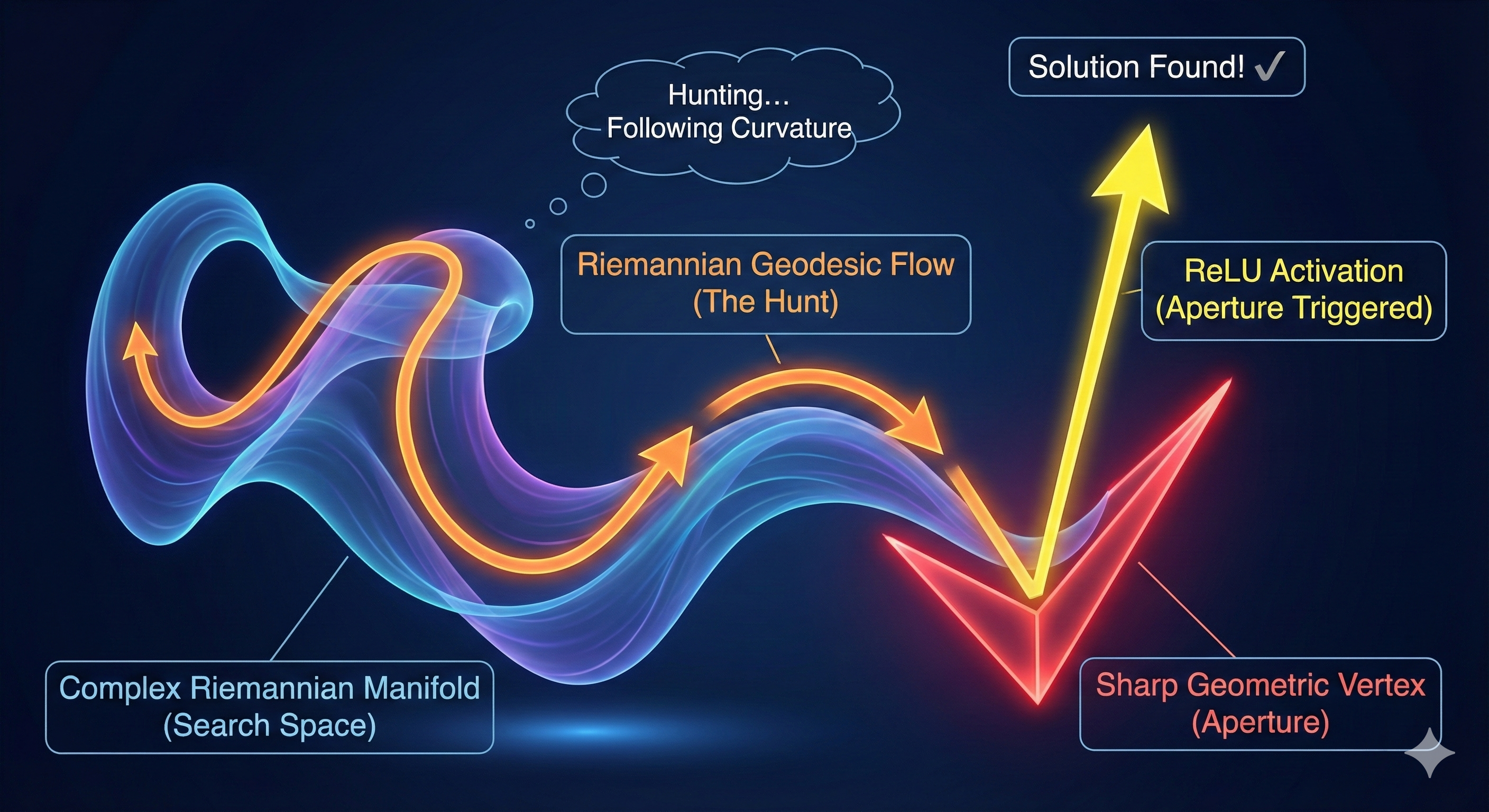
3. The Riemannian "Hunt"
The system "flows" along the complex, curvy manifold, hunting for the solution. It doesn't know where the answer is; it's just following the curvature. When it hits that sharp geometric vertex—the intersection point—the curvature forces the state into the "Aperture," triggering the activation.
2. Mathematical Formulation: The Theta and Delta Operators
- The state at step is defined as:
- : The state at the current step.
- : The rotation/transformation (The "Delta" or "Theta" shift).
- : The "Puncture" (The non-linear activation that filters the result).
- The $\theta$ (Theta) Phase: Defines the circular orientation of the state vector, generating the Berry Phase (Geometric Memory) that allows the system to remember its state without physical contact.
- The $\Delta$ (Delta) Ripple: The "Derivative of Rotation" () that calculates the pitch required to "squeeze" data packets forward along the manifold.
- The Result: Because Rotation = Translation, data (the "Milia Bundle") is carried passively by the geometry, eliminating the heat loss and friction of traditional "push" logic.
The Input
Entangled photons (qubits) generated via SPDC (Spontaneous Parametric Down-Conversion) in a PPLN waveguide.
The Action
We don't flip bits; we rotate the state vector () recursively.
The Logic
We look for the 'overlap' of subspaces (your intersecting circles).
The Trigger
When the rotation aligns with the solution's geometry, the system achieves symmetry, allowing the signal to pass through the 'Puncture' ().
4. The Hardware: PPLN as a Geometric Learning Engine
Conclusion: A Unified Framework for Geometric Intelligence
- From Genesis: We take the core mathematical language of Riemannian Intelligence. The concept of a stable Base Manifold and a dynamic Tangent Corpus provides the architectural blueprint for a system that can learn without forgetting.
- From Echo: We derive the hardware-level proof with Evolutionary Dissipative Circuit Design (EDCD). By treating a device's unique noise profile as a 'decoherence mold,' EDCD proves that geometric filtering can be physically instantiated, turning environmental noise into a computable, verifiable asset.
- From Carbonite: We apply these principles at the macro scale. The Factor Beta (β) is a real-world, systems-level application of a directional derivative. It measures the 'curvature' of a complex entity (like a supplier) relative to the market, quantifying its geometric risk.
- Geometric Encapsulation: An identity is not a collection of fields, but a cluster of quantized data packets (solitons) contained within a unified geometric envelope. This topological boundary protects the integrity of the core identity from external perturbation.
- Topological Resilience: We utilize a structure analogous to a Hopf Fibration, where every constituent data packet is geometrically linked to every other. An attack on a single data point would require distorting the entire topological structure, making localized fraud geometrically infeasible.
- Dynamic Equilibrium: Instead of being static, solutions exist in a state of dynamic equilibrium. They are immediately available when queried but remain fluid and non-static, preventing the vulnerabilities associated with fixed, predictable targets.
- Market Geodesics: Wealth trajectories follow the path of least resistance (Geodesics), ensuring efficiency regardless of specific market points.
- The Journey Invariant: If a participant understands the "Curve" of their journey, their target efficiency remains constant, effectively insulating them from systemic collapse.
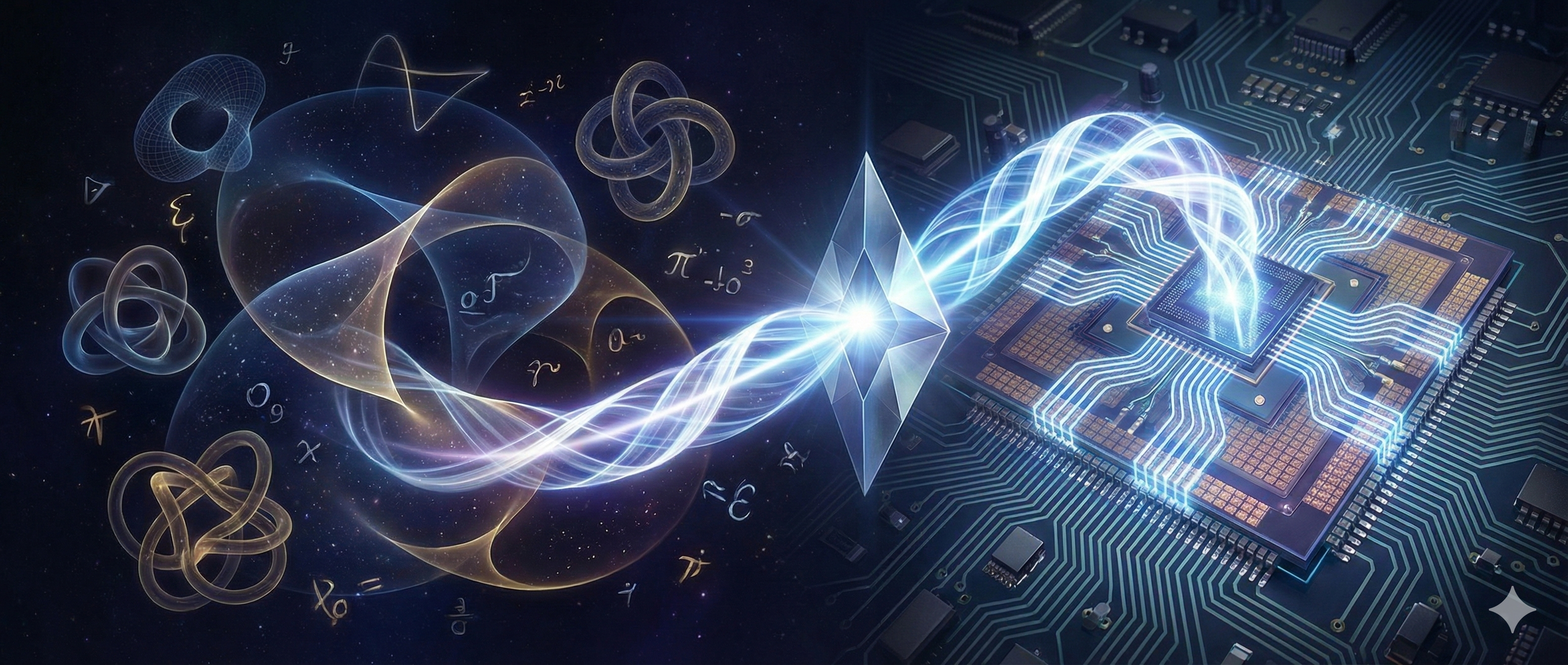
This protocol details the 'Aperture'—a non-linear optical component that creates a 'puncture' in Hilbert space, allowing only solutions with specific rotational symmetries to propagate. It serves as the physical manifestation of the high-level principles discussed in the main paper.
Read the Aperture Protocol